Hunt
Hunts anomalies across the whole attack surface instead of waiting for an alert first.

AI agents that investigate threats, make the call, carry out containment, and learn from every case. They work on top of the SIEM you already have, with nothing to replace.
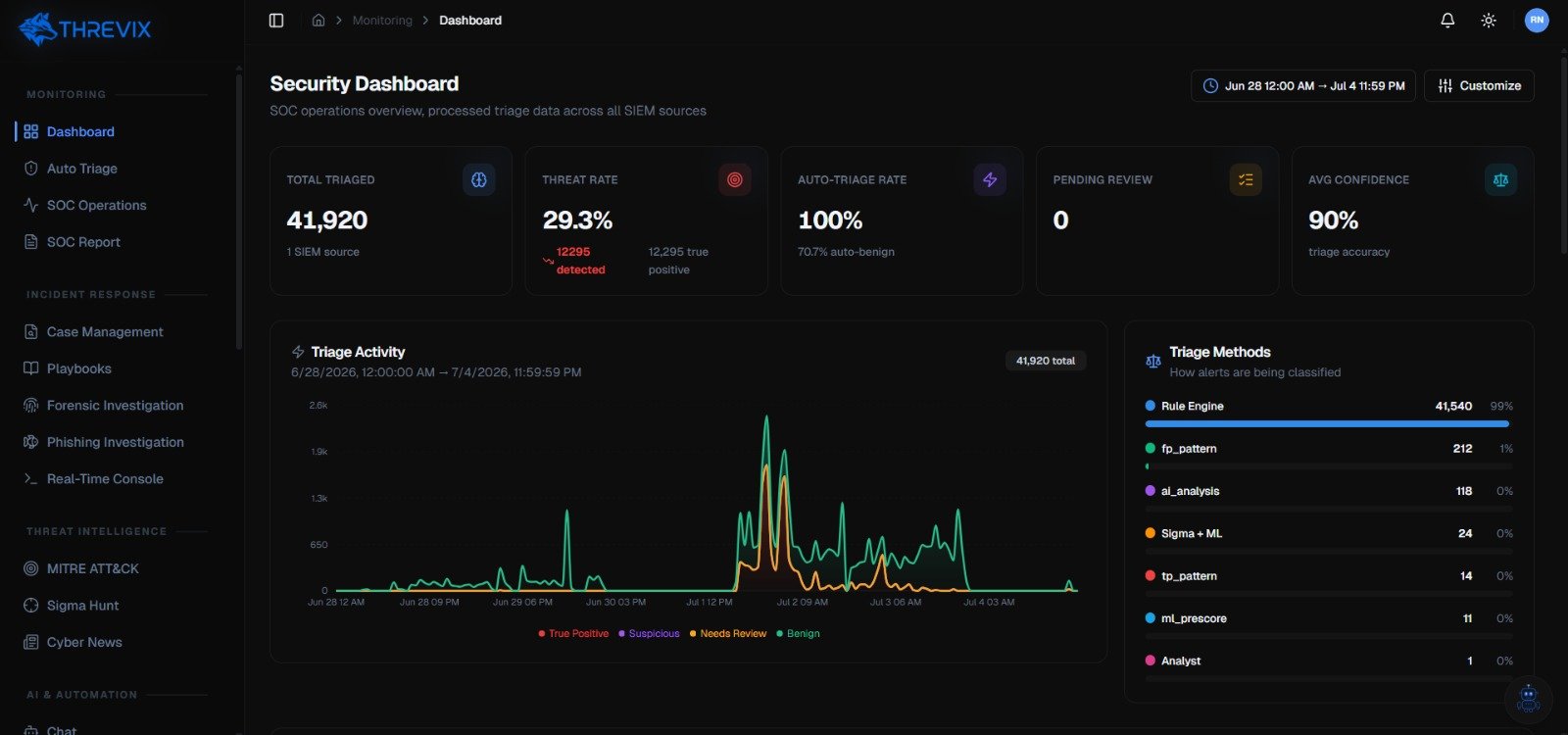
Security teams are not short of data. What they lack is the time to read all of it, and that is how a real attack slips past among thousands of ordinary warnings.
Traditional tools stop at the notification. Everything after that stays human work, one alert at a time, all night.
Threvix investigates, decides, and closes cases on its own, then uses the result to sharpen the next detection.
Analysts hop between SIEM, EDR, threat intel, and tickets just to understand one event.
Threvix reads from the sources you already run, so there is no migration and no system replacement.
Five stages turn without a pause. Every turn leaves behind a record that makes the next one faster and more accurate.
Hunts anomalies across the whole attack surface instead of waiting for an alert first.
Separates false positives from real threats, complete with reasoning you can read.
Pulls context from logs, EDR, and threat intel, then builds the timeline of the event.
Runs containment steps at the permission tier you set.
Keeps the outcome of every case to sharpen detection and lower the noise.
Learning goes straight back into the hunt stage
Not one do-everything model. Each role carries its own expertise, coordinated by a single orchestrator that knows who should work when.
The master controller. It classifies every incoming event, picks the right agent, and keeps collaboration between agents pointed in one direction with clear limits.
Assesses incoming alerts, drops false positives, and passes on what genuinely matters.
Builds the timeline across log sources and maps the path the attacker took.
Isolates hosts, revokes sessions, and blocks indicators within the permission in force.
Hunts hidden threats using hypotheses and MITRE ATT&CK technique coverage.
Dissects dangerous samples, maps behaviour, and extracts new indicators.
Writes and maintains detection rules so they stay relevant to the newest threats.
Blends external intel with internal findings to judge how relevant it is.
Collects digital evidence that holds up, ready for further investigation.
Tests the defence from the attacker side to find gaps before they are exploited.
Slots security checks into the release pipeline without slowing the team down.
Beyond the work you ask for, Threvix runs five routine operations that keep your environment watched.
Every incoming alert is filtered, enriched, and scored without waiting in an analyst queue.
Hypotheses run on a schedule without waiting for a warning, so quiet threats stay visible.
Containment runs straight away, at the permission tier already agreed with your team.
Verdicts, analyst corrections, and old case outcomes are used to tune detection thresholds.
Recurring work runs on schedule without needing to be asked again every day.
Every action sits in one of four tiers. You decide how far an agent may move on its own, and from which point a person has to approve.
Reading data, correlating logs, and pulling threat intel.
Runs freelyCreating tickets, tagging, and sending notifications to the team.
Runs with a recordIsolating hosts, revoking sessions, and blocking indicators on a device.
Analyst approvalChanging firewall rules and security control configuration.
Admin approvalLanguage models are expensive when called for everything. The analytics layer filters first, so agents only handle what genuinely needs reasoning.
Threvix leans on the security stack you have today. No system needs replacing, and no data needs moving.
Splunk, Elastic, QRadar, Sentinel
Endpoint telemetry and response
AWS, Azure, and GCP
Firewall, proxy, and NDR
Ticketing and escalation flow
Commercial and open indicator feeds
Inbound and outbound message filtering
Checks inside the CI and CD pipeline
Sandbox and file reputation engine
Findings synced with test results
We will walk you through Threvix using threat scenarios relevant to your own systems. Thirty minutes, no cost, no commitment.